
Name day of blessed Alojzije Stepinac celebrated in the cathedral in Sarajevo
uto, 12. veljače 2019. 12:25
In Sarajevo's cathedral of the Sacred Heart of Jesus, holy mass was led by Msgr. Tomo Vukšić, Military Bishop of BiH on the name day of Bl. Alojzije Stepinac.
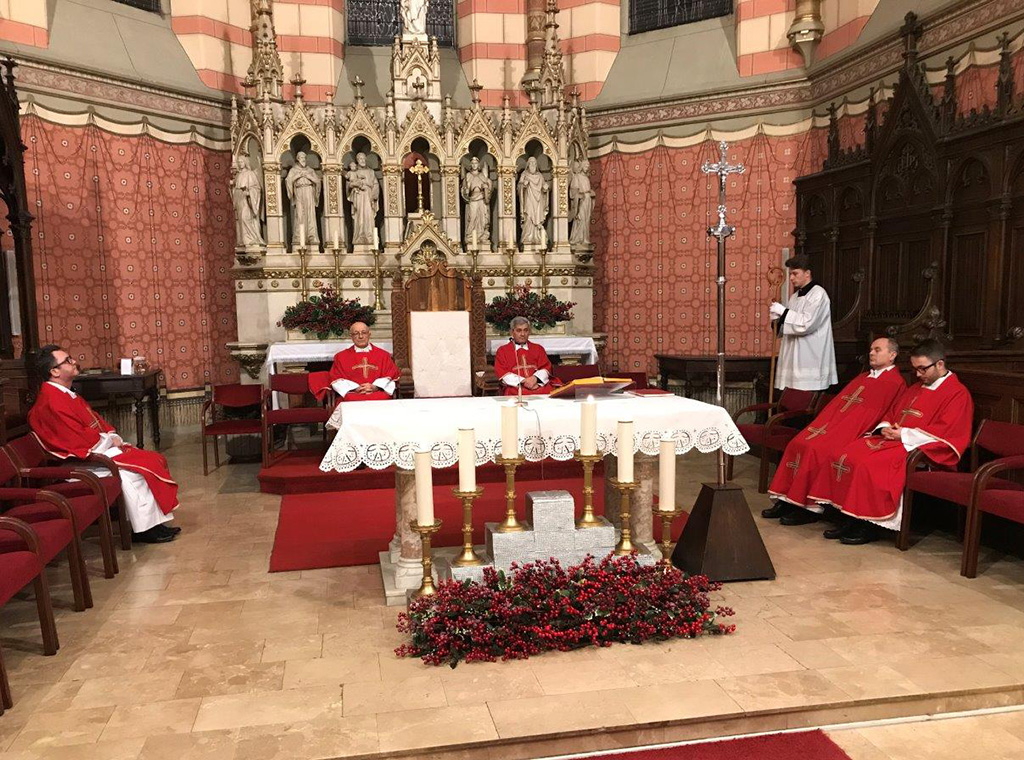
With Msgr. Vukšić, five other priests concelebrated, and the present were greeted by the rector of the Cathedral, Msgr. Ante Meštrović. Among other things, in the greeting he stressed that we wants to “with this Mass celebration in the cathedral of Sarajevo, associate with the Croatians around the world and mark the name day of Blessed Alojzije Stepinac whose virtuous life and martyrdom death, despite the communist persecution, has been recognized and honoured by God's people”.
At his sermon, Bishop Tomo described the character of Bl. Stepinac as a “patient witness and martyr of unity”. Recalling that the persecution is a constant in the history of the Church, which Jesus also pointed out to his disciples at the Last Supper, he emphasized the call to holiness as the task of each successor of Christ. In addition to the diversity of the ways of doing so, he highlighted martyrdom as “the highest form of Christology, love and fulfilment of God’s will, and hence the highest possible form of personal consecration”.
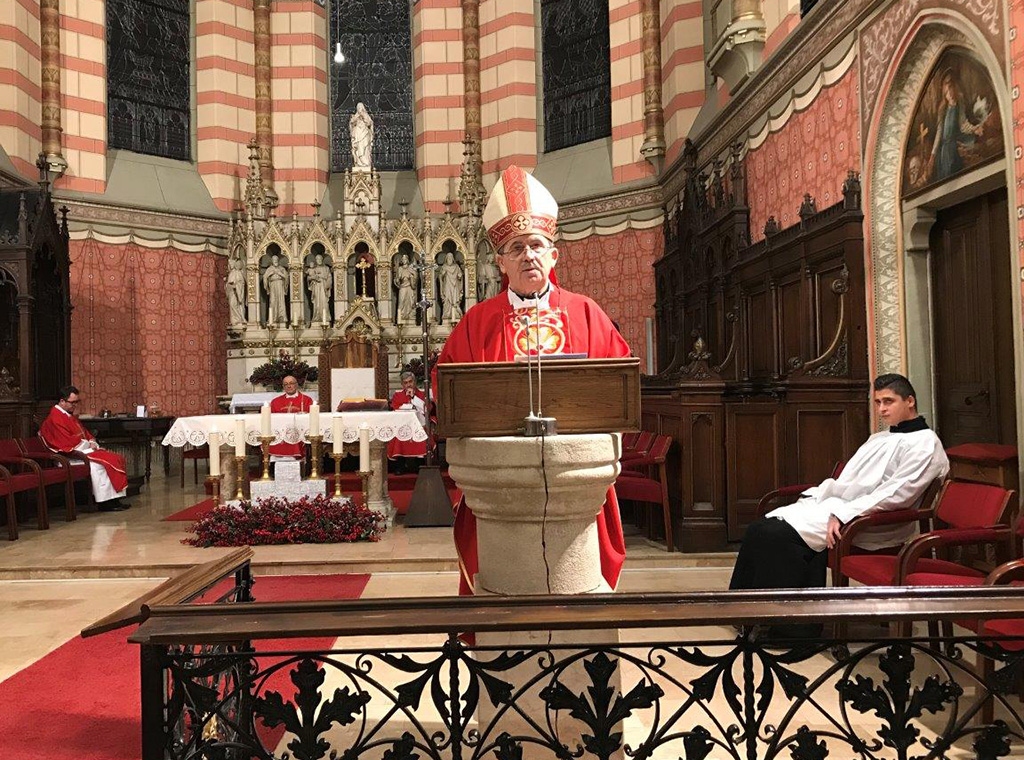
“As it is well known, then the government offered the establishment of a national church, separated from Rome, and in turn Stepinac would not have been on trial. The then dictator, while Stepinac was at the end of May and early June 1945., in prison for 15 days for the first time, he summoned some representatives of the clergy, and told them: ‘I would say on my behalf that our Church should be national, more adaptable to the nation. [...] I would like to see that the Catholic Church in Croatia now, when we have all the conditions, has more independence. That is what I want, that is the basic question, that is the question that I would like to solve, and all the other questions are secondary issues that will be easily solved’ (Benigar) As another communist leader, referring to Stepinac, said: ‘We would have nothing against his Croatian nationalism, but we cannot tolerate his attachment to the Roman Pope’ (Milovan Đilas to Ivan Meštrović)”, the bishop said and mentioned Stepinac’s response as sacred and clear: “They would like the National Church, a Russian-style Church, commanded by Stalin. To such a church, they would gladly give grants, wages, return the estates, they would celebrate it in the newspapers, and so on. But the question is whether such a Church would deserve the universal name of the Church of Christ”.
With regard to the blessed Stepinac’s patience in his trials, he stressed that “even in his difficult illness, when they tried to offer what they considered to be a favour to him, Stepinac did not allow the Christianity, truth and good reputation of the Church to be questioned”. “In this sense, we should mention only one passage from the letter written in 1958. to the then bishop in Skopje, Msgr. Smiljan Čekada. We choose him, because msgr. Čekada later preached in this cathedral as the Sarajevo Archbishop. Stepinac wrote to him: 'They brought me a bloody injustice and now I should have to ask for mercy and tell them that they are right, not the Church, when it raised its voice to their injustices (...) You recall the repeated statements of marshal Tito, that while he is here, I will not be in Zagreb. Mister marshal probably thinks that I long for Zagreb very much. And I haven’t got any desire to go to Zagreb or any position. My only ambition in this world is to endure and to die in the grace of God”.
During the Mass, the theologians of the Vrhbosna theology seminary ministered and animated the mass with their singing.

.jpg&w=420&h=235&zc=1&hash=8979a7fb41970e40e9ab904ce5ae0d0e)

.jpg&w=420&h=235&zc=1&hash=6fa2ac5871e71da00635f983489ad887)
.jpg&w=420&h=235&zc=1&hash=c9b93ea24d984092be7aa05378fb14e7)