
A quarter of a century of Tuzla's KŠC
sri, 07. listopada 2020. 09:54
The Catholic School Centre (KŠC) Sveti Franjo in Tuzla celebrated its 25th anniversary on October 5th. On that occasion, Holy Mass was celebrated and a documentary film about the activities of this educational institution in the City of Salt was shown.
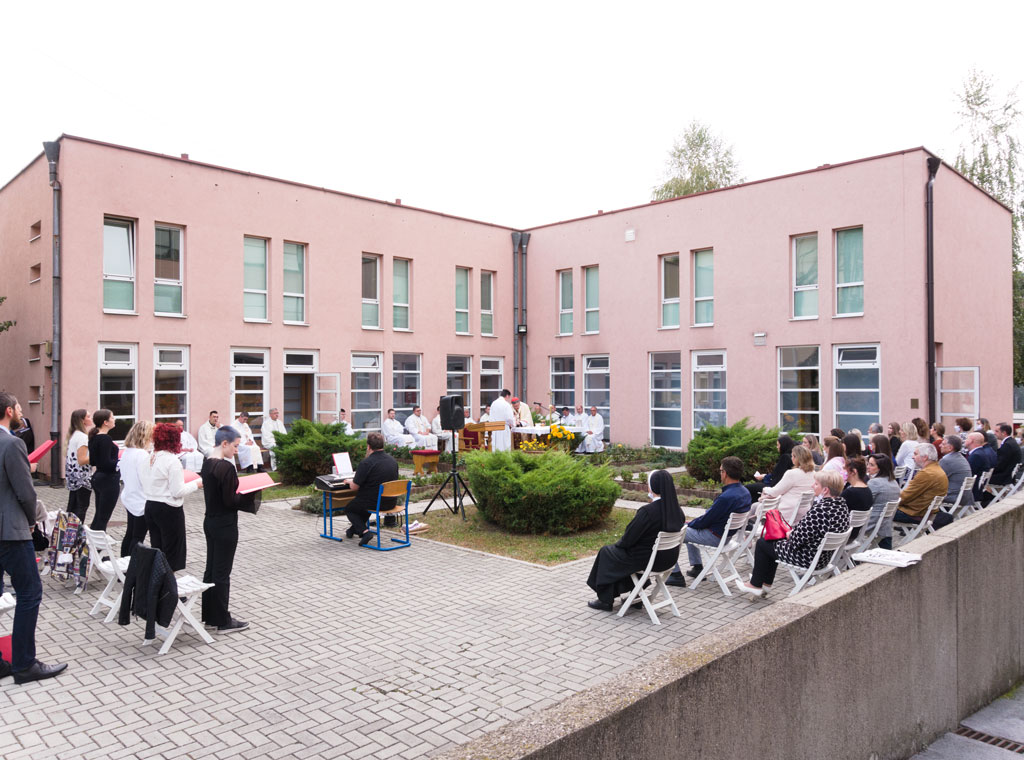
The celebration brought together people who accepted and put in realisation the idea of creating the Tuzla’s Catholic School Centre Sveti Franjo. Together, they remembered 1995., when professors and students were just tenants at the Mechanical School in Tuzla, after which, thanks to the efforts of many, today's recognizable building emerged.
The celebration of School Day and a quarter of a century began with a Holy Mass in the courtyard of the Centre, led by the Archbishop of Vrhbosna cardinal Vinko Puljić with the concelebration of about 20 priests, among whom were the former directors of this Centre: OFM Martin Antunović, Msgr. Luka Tunjić and rev. Vlatko Rosić, as well as the current director, rev. Marko Zubak.
After the Holy Mass, those present gathered in the amphitheatre of the Centre where they watched a documentary about the life and work of the Tuzla KŠC for 25 years.
In his welcome speech, Director Zubak recalled the goals of Catholic education in BiH that were set by the now retired Auxiliary Bishop of Vrhbosna, Msgr. Pero Sudar, which are: understood and accepted student; brought up and educated, ie a young person ready for life and enthusiastic about life.
“Celebrating the jubilee means being grateful to those who have invested their effort, knowledge, selflessness and skill so that we too can live and multiply from that generosity today. Everything we do for ourselves will end with us, and what we do for others will live permanently. There is no more beautiful and bigger task than this, to lead our smallest ones with our heart and mind and look at the greatest in them”, said director Zubak and thanked all those who were “enthusiastic” about the idea of creating this Centre.
Numerous employees and directors of the Centre spoke throughout the documentary. Special thanks were sent to Bishop Pero.
“These schools succeed in their basic intention, ie to encourage diversity, to build a true and concrete community among students. People in BiH, despite all the painful experiences or precisely because of them, are very open and ready to accept and live together”, was the message of Msgr. Sudar.
A big role in the construction of KŠC in Tuzla, which was initially led by rev. Jozo Batinić, in the famous Tuzla street Kloster, had the nuns of the Daughters of God’s Love who still work within the Centre, and are recognized as the founders of education in Tuzla. Also, the Franciscans of Tuzla made an exceptional contribution to the return of the Kloster.
Many of these facts are shown in the documentary through the rich historical archive of the founding of the school to the present day.
During the ceremony, Archbishop Vinko handed to the now high-school student, Mia Hodžić, the highest recognition at the level of the Catholic School System for Europe - the Lukić-Dlouhi Award given to a primary school student for exemplary learning and behaviour and special results in extracurricular activities.
“May this jubilee be an encouragement for us not to lose sight in these tiring and gloomy atmospheres we are experiencing”, the cardinal said, also referring to his life experience. “I learned a lot during school. I didn't memorise much. But I remember every professor and the way he was. Therefore, dear teachers and professors, remember that you speak more with your personality than with your words. Your personality is important because many of us want to be like you. I wanted to be like a priest I cared for very much. It is most valuable to invest in young people who are our future”, said Cardinal Puljić, who has followed and supported the beginning and development of Catholic education in BiH from the very beginning.
During the event, professors and students said that the students of KŠC gained immeasurable contribution to the knowledge here. Many of them today spread this knowledge and upbringing around the world, and those who remained in Bosnia and Herzegovina are prominent doctors, architects, engineers, computer scientists, scientists and professors.
.jpg)
.jpg)
.jpg)
.jpg)
.jpg)
.jpg)
.jpg)
.jpg)
.jpg)
.jpg)
.jpg)
.jpg)
.jpg)
.jpg)
.jpg&w=420&h=235&zc=1&hash=8979a7fb41970e40e9ab904ce5ae0d0e)

.jpg&w=420&h=235&zc=1&hash=6fa2ac5871e71da00635f983489ad887)
.jpg&w=420&h=235&zc=1&hash=c9b93ea24d984092be7aa05378fb14e7)
