
Bishops express hope for more fair October elections in BiH
čet, 12. ožujka 2026. 11:03
The regular session of the bishops of the Bishops' Conference of Bosnia and Herzegovina (BK BiH) and the Croatian Bishops' Conference (HBK) was held on March 9th in the premises of the Ordinariate in Banja Luka.
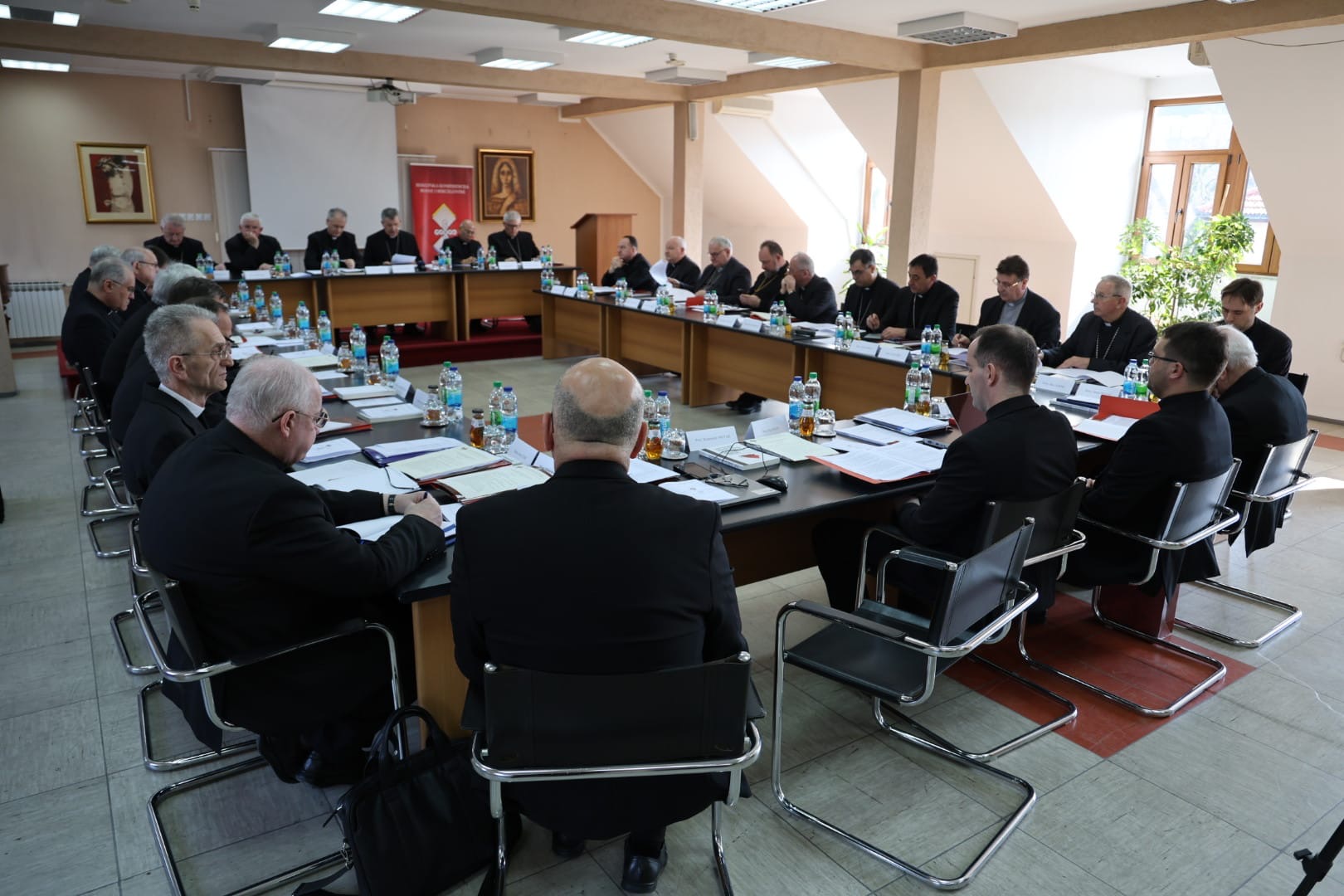
This was the 28th regular joint session of the two bishops' conferences, attended by 27 bishops, including the Apostolic Nuncio in BiH, Francis Assisi Chullikatt.
Gift and Task
At the beginning, welcoming speeches were given by the President of the BK BiH, Archbishop of Vrhbosna Archdiocese Tomo Vukšić, and the President of the HBK, Archbishop of Zagreb Dražen Kutleša.
Msgr. Vukšić first welcomed the three newly ordained bishops: auxiliary bishops of Zagreb, Msgr. Vlado Razum and Msgr. Marko Kovač, and the military bishop in BiH, Msgr. Miro Relota, OFM. He then presented the central themes of the session and referred to two important church events in 2026: the Jubilee on the occasion of the 800th anniversary of the death of Saint Francis and the “arrival” of the earthly remains of Saint Teresa of child Jesus to Croatia and Bosnia and Herzegovina on the occasion of the 100th anniversary of her canonization.
In the context of social events, he highlighted the fact that European integration for Bosnia and Herzegovina is “on hold”, while “hard words” continue to prevail in the public sphere. He expressed hope “that justice and respect for the human rights of every person will finally prevail, and that the abuse of poor electoral laws and the humiliation of dignity in the form of outvoting those who, due to demographic reasons, are not guaranteed the right to elect their own representatives at various levels of government, which applies most to the Croatian people”.
Finally, he reminded that the international agreement that BiH signed with the Holy See in 2007 has been almost forgotten and that the authorities have still not implemented most of what they signed, not even the issue of religious holidays as non-working days.
Archbishop Kutleša of Zagreb said that the joint session was “a gift and a task: a gift of fraternal unity in faith and service and a task of persistent witnessing to the Gospel to our people in Croatia and Bosnia and Herzegovina”. Thanking the host Bishop, Msgr. Željko Majić, he emphasized that in the Banja Luka diocese, “the wounds of the Church in its members, but also the strength of Easter hope that shines through them”, are strongly felt. He said that the joint journey and cooperation of the two conferences have always been and remain imbued with a sense of responsibility for each other.
The President of the HBK also reminded of two events that will bring together young people and families this year: the Meeting of Croatian Catholic Youth in Požega and the National Meeting of Croatian Catholic Families in Aljmaš.
Sad statistics
Then the host of the meeting, Msgr. Majić, expressed his gratitude to all those who show closeness to the diocese he leads. "There are quite a few who perceive the Banja Luka diocese as a diocese in decline, and they speak of the faithful of this local Church as the remains of the remains. It is true that statistical data support this thinking, because from the pre-war more than 120 000 faithful, we ended last year with slightly less than 23 000", said the Bishop of Banja Luka, expressing his hope that so much shed blood of witnesses to the faith would give birth to new life in his diocese. Among other things, he recalled that on December 9th, 2014, nihil obstat was obtained - approval from the Holy See to initiate a diocesan process for four priests killed in odium fidei during World War II in his diocese, for which a diocesan postulator was appointed. He emphasized that the process has been opened for the priests and one nun killed in odium fidei in the last war.
Before the beginning of the working part, the participants were briefly addressed by the Apostolic Nuncio, Msgr. Chullikatt.
May the respect for human rights prevail
In the working part, a report was presented on the work of the Council of HBK and BK BiH for the Croatian believers abroad. Along with the report of the Director of the Pastoral Care for Croats abroad, Rev. Tomislav Markić, certain challenges in finding new pastors for the Croatian believers abroad, as well as the migration of Croatian believers within various countries of the European Union, were also presented.
Since 2026 marks the 60th anniversary of the Directorate of Pastoral Care for Croats Abroad, 80 years of Croatian pastoral care in Germany and Austria, and 100 years since the founding of the Croatian Franciscan Custody of the Holy Family for the USA and Canada, it has been announced that these anniversaries will be marked with a ceremonial session of the Council of the HBK and BK BiH for the Croatian believers abroad, which will be held on April 13th in Zagreb.
Bishop of Varaždin, Msgr. Bože Radoš, Chairman of the Episcopal Commission for the Pontifical Croatian Institute of St. Jerome in Rome, reported on the official visit to the Institute in January 2026. He also presented the Lenten campaign of Croatian Caritas, The Week of Solidarity with the Church and people in Bosnia and Herzegovina, the central event of which this year was the Eucharistic celebration on Sunday, March 8th in the Church of St. Nikola Tavelić in the parish of St. Michael the Archangel in Tomislavgrad.
This was followed by a report by Bishop of Krk, Msgr. Ivica Petanja, President of the Commission of HBK and BK BiH for Croatian Martyrology, on the achievements of the Commission to date, as well as a report by Bishop of Poreč and Pula, Msgr. Ivan Štironja, President of the Council of the HBK for missions, on the activities of the Directorate of the Pontifical Mission Societies.
Bishop of Mostar-Duvno, Msgr. Petar Palić, and Auxiliary Bishop of Đakovo-Osijek, Msgr. Ivan Ćurić, presented the text of the document Ratio nationalis on priestly formation, emphasizing that it is a document that contributes in a high-quality and serious way to the reflection on priestly formation, taking into account the specificities that characterize the ecclesiastical and social context of the two conferences.
Furthermore, Archbishop of Split-Makarska, Msgr. Zdenko Križić, and Auxiliary Bishop of Zagreb, Msgr. Ivan Šaško, presented the work to date on the Croatian translation of the Missal.
In addition, the program of the National Meeting of Croatian Catholic Youth, which will be held on May 2nd and 3rd in Požega, was presented, as well as the National Meeting of Croatian Catholic Families, which will be held on September 19th and 20th in Osijek and Aljmaš.
The bishops also paid special attention to the issue of regulating public appearances by leaders of charismatic groups and leaders of spiritual retreats.
After the joint session, a statement was issued in which the hope was once again expressed that justice and respect for the human rights of every person would finally prevail, and that the abuse of poor electoral laws and the humiliation of dignity in the form of outvoting would cease.
Holy Mass on the eve of the bishops' meeting
On March 8th, in the Banja Luka Cathedral of St. Bonaventure, the Eucharist on the eve of the meeting of the members of the BK BiH and the HBK was celebrated by Msgr. Vukšić, and the sermon was delivered by Apostolic Nuncio Chullikatt. At the beginning, Bishop Majić greeted those present and pointed out that each Sunday of Lent has its own name, except for the third, which was for a long time Nameless, but was declared Solidarity Sunday 19 years ago, when the faithful from Croatia help the Church in BiH with prayers and gifts, and expressed deep gratitude for the prayers, sacrifices and works of love with which the Church in Croatia accompanies the Church in BiH.
Nuncio Chullikatt emphasized in his homily that true Christian conversion is not just a moral effort or a superficial change, but a response to God's call that precedes it. He explained that it is a return to the living God who first seeks man and touches his heart in order to transform him from within. Following this, he emphasized that Lent is a time of listening and gratitude, in which one discovers that the human being is loved beyond measure, and not a time for fear. He added that conversion means abandoning the hardness of heart and bearing real fruit through the gift of oneself, which strengthens communion and heals the wounds of the Church.
The liturgical singing was animated by a mixed choir composed of singers from several parishes under the direction of sister M. Blanka Jeličić.

.jpg&w=420&h=235&zc=1&hash=bfa7d2c3c6d2fc4282187f8a3ace1b12)


