
The number of Jasenovac victims – a special ecumenical stumbling rock
pon, 18. svibnja 2026. 08:57
From an ecumenical perspective, we wonder about the real number of innocent victims in the camps during the NDH, and especially the camps in Jasenovac and Stara Gradiška, because the real number of victims has become a major stumbling block in the national, political, church and ecumenical fields.
Written by: Dr. Niko Ikić, emeritus
It should be emphasized right away that a single innocent victim cries out for condemnation, not just of one person, not just of the pope, patriarch or politician, but of the entire society, and especially of the Christian Churches, and this without calculation because the crime has neither nationality nor religion. Personally, this is exactly what we do first when we talk about the Jasenovac and all other victims.
What is the real number of victims?
With the question asked, we are immediately introduced in medias res of the problem! How many were there? When it comes to condemning a crime, the number is not so important! When we are expressing the truth about a crime, it is very important! When we talk about ecumenism in our area, the real number of camp victims is extremely important. But getting to the true number of victims is not easy, especially when it is exaggerated, minimized or disputed and denied, when one avoids facing reality and facts... Then such behavior becomes a major stumbling block, especially when one manipulates unproven numbers.
When the number of all war victims, as well as Jasenovac victims, is at stake, then there is more than one truth. Is that possible? It has been for decades with us! Colloquially speaking, we have a Serbian Orthodox and a Croatian Catholic "truth". Everyone has their own truth from which they do not deviate, and the real and actual truth is only one and for now it seems unrealistic with little chance of becoming real. This is precisely the stumbling block to the ecumenism of the Catholic Church in Croatia and the Serbian Orthodox Church. And this has been the case for about 80 years from the Jasenovac perspective!
The obstacles on the way to a real and true number of Jasenovac victims are diverse: from national to political, from church to ecumenical, from wartime circumstances and difficulties to the willingness or unwillingness to face the truth. And truth in love must be the foundation of sincere dialogue and ecumenism. There is no ecumenism to the detriment of truth (Ut unum sint, no. 18). Also, there is no truth or true ecumenism in our country without a real number of victims. Let this text be an incentive for honest research into the truth about these victims.
What does the numbers game suggest so far?
When the communist authorities in 1947 began researching the number of all war victims, not out of ecumenical motives of reconciliation and truth, but because of larger monetary reparations claims, the generally accepted opinion is that the number was deliberately inflated so that the former Yugoslavia would receive as much war compensation as possible. On the other hand, it seems possible that the world powers supported such inflating because they saw their interest in the greatest possible quarrel between Croats and Serbs, and the Germans had to pay.
But let's move on to the specific numbers game of all war victims first. At the meeting of the International Reparations Commission in 1946/'47 in Paris, Edvard Kardelj came up with the figure of 1 700 000 for all war victims of the 1941-1945 war in the territory of the former Yugoslavia. The number of 1 700 000 was reached in March 1947 by comparing the percentage growth of other neighboring similar nations, and the demographic overview of victims included: unborn who could have been born; expelled, missing and actual losses - but from all possible reasons (death due to illness, for example, because there were no medicines due to the war)...
According to Bogoljub Kočović (born in Sarajevo), the demographic victims of the war amounted to as many as: 1 985 000, of which: 330 000 unborn, 650 000 expelled, and 1 014000 of all other victims among them and the names of survivors (cf. Victims of the Second World War in Yugoslavia, Svjetlost, Sarajevo, 1990).
At that time, war reparations were estimated at 47.5 billion dollars. The Germans were forced to pay 30 billion. They, on the other hand, are demanding a description of the actual material suffering of the war and a concrete list of human victims that could be controlled. The Federal Executive Council (SIV) of the former Yugoslavia was stalling. They were obviously afraid of the truth! After a long time, the SIV finally prepared a survey of victims only on June 17th, 1964, when the Census Commission was established (about 30 000 people participated). They came to the conclusion that the total number of all war victims (killed, killed in combat, missing and survivors) was 1 107 172. Now it is already 700 or 800 thousand less, depending on which number you start from. Of that number, killed, killed in combat, deceased and missing is 597 323. Among those who died in any way were: Serbs 346 740 or 58%; Croats 83 257 or 15.9%; Jews 45 000 or 7.5%; Slovenians 42 027 or 7%; Muslims 32 ,300 or 5.4%; Montenegrins 16 ,276 or 3.1%; Macedonians 6 724 or 1.1%; Albanians 3 241 or 0.5%; Hungarians, Turks and Slovaks 0.5%, and others and unknown 2.5%.
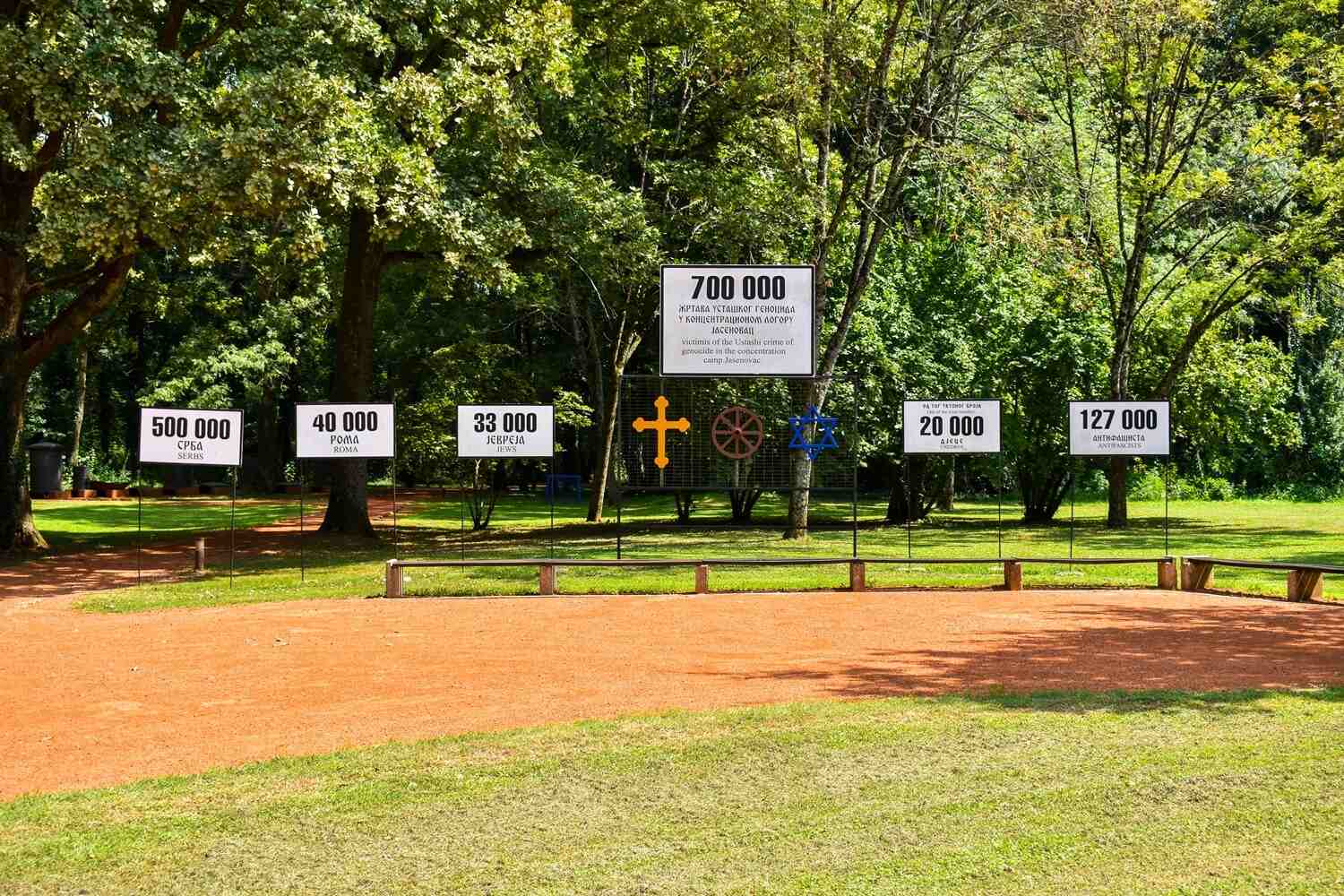
When talking only about the victims of the Jasenovac camps, the numbers are also very different. Back on October 30th and 31st, 1997, Dr. Milan Bulajić, at the International Conference and Exhibition on Jasenovac in New York, spoke arbitrarily and tendentiously about a million Jasenovac victims. Vladimir Dedijer mentions 700 000; General Terzić million; historian Radomir Bulatović accurately states 1 110 229 victims of Jasenovac; The Serbian Orthodox Church constantly suggests 700 000 (never with any evidence); on the other hand, Vladimir Žerjavić reveals 92 000 in Jasenovac and 92 000 in Bleiburg (cf. Losses of the Yugoslav population in the Second World War, Yugoslav Victimological Society, Zagreb, 1989).
Those who accepted the figure of 700 or more thousand victims in Jasenovac consider and evaluate that camp, together with Gradiška, exclusively as a "death factory", "death industry", "slaughterhouse", "execution site" with the aim of genocide, all in the absolute and literal sense, nothing symbolic or figurative. And the aforementioned 1964. census specifically states that a total of 59 188 people died in Jasenovac and Stara Gradiška. Of these: Serbs 33 944; Jews 9 044; Croats 6 546; Muslims 949; Roma 1 471; Slovenes 194; Montenegrins 38; Macedonians 7; Hungarians 60; nationally unidentified 6 850 and others 85.
International sources most often speak of around 85 000 victims in the Jasenovac and Gradiška camps. They mostly stick to the name list on the Jasenovac victims' plaque, and in 2013 the names of 83 145 victims were listed there.
The research result of all the victims from 1964. was devastating compared to the communist presentation and public appearance in 1947. This is especially true for the victims of the camps. That is why the 1964. list was banned from printing and public use. It was a state secret. It was only printed in 1992., but only for the state administration, not for the public. Adil Zulfikarpašić managed to obtain this list, which he published in 1998 on behalf of the Bosniak Institute in Zurich.
Opponents of the above numbers game cite counter-data, for example, that in 1941. there were 1 200 prisoners in Jasenovac, while previous communist sources claim that 10 700 were executed in the same period (cf. Igor Vukić, Radni logor Jasenovac, p. 299). How is that?
Recently, some researchers have also largely disputed the figure of around 80 000. Franjo Tuđman researched the death registers and presented a number of 30 to 40 thousand of all Jasenovac victims (cf. Bespuća povijesne zbiljnosti, Zagreb, 1989). So much for the numbers game!
Forest of different viewpoints
My God, just one question, and so many diametrically different answers. A forest of significantly different viewpoints and numbers. Who is right? What is true here, and what is untrue? What is fictitious here, and what is objective, what is real, and what is unrealistic, what is symbolic here, and what is real…? Is it even possible to reach the truth here, one, real, realistic, historical, moral…?
The point of this text is not to prove this or that truth, but rather the question is: What is truth? Quid est veritas? And the second meaning is the question: Quanta est nobis via oecumenica? Both questions are difficult to answer! At the heart of the text is the encouragement and suggestion to investigate the truth. Not investigating the truth would be the greatest sin against the victims! In the investigation, however, there must be neither “colouring” nor hiding the truth, and even less exaggeration, politicization, manipulation, mythologizing… And the victims themselves expect the naked truth! That is why we need a “purification of historical memory”, as Saint Pope John Paul II expressed it in the encyclical Ut unum sint, no. 2. In the purification of memory, we should forget the evil and remember the victims (Branislav Rajković, Vidoslov 96 (2025) 135-137).
How to get to the truth about the victims of Jasenovac?
If it is true that there is no greater darkness than ignorance (Shakespeare), on the other hand, that he who sees the goal knows the way (Exupery), and despite the fact that the search for historical truth is a via dolorosa (Škvorc), then it is understandable that the truth seeks light, because only through calm and clear water can the bottom be seen. It is pointless to write on water, that is why it is necessary to write the established truth on stone. It is already written in blood, it only needs to be discovered. The inscription in Delphi: Know thyself, is also valid in this case, although people are afraid of the truth because they are afraid of reality!
Assuming that the truth is genuinely desired by both political leaderships, both church leaders, theologians, ecumenists, cultural and scientific historical researchers, domestic and foreign, and assuming that proven results are readily accepted on both sides, then the path to the truth would be relatively easy. At least conceptually. And that would greatly help the ecumenical path. However, assumptions are nowhere near realistic realization! That is why the path to the real number is blocked by prejudice and unhealthy national pride, because no one accuses themselves, but justifies themselves with unfounded arguments. That is not actually justification, it is decay! If there was good will and openness to the truth about the real victims of Jasenovac, as well as all other war camps of the Second World War and the last war, then it would be enough to form research commissions, domestic and international, on behalf of the institutions indicated above and give them enough time. They would first have to agree on common research methods, in which the proven results of one commission would be handed over to the other, in which there would also be occasional joint sessions, confrontations and harmonization.
According to the proposal of Thomas Aquinas, research should first start from a small stream before swimming into the sea. His figurative speech means starting from easier topics and problems and then stepping towards more difficult ones. Thomas notes that one should always keep in mind the purity of conscience and avoid arguments (Epistola exhortotaria de modo studiendi ad fratrem Joannem, in: Opuscula theologica 1, 1954., 451).
However, discussions should not be just an exchange of data and numbers, but an exchange of truth and love. The commissions should not be burdened with any other motives and interests than the spirit of proven truth and love that the prophet Daniel courageously sought in the case of the unjustly condemned Susanna (Dan 13,42-60). This should be our true "via oecumenica"!
Food for thought
In order to get to the nut, the nut shell must be broken. For those who want to, it is easy, and for those who don't, it is impossible. Still, things should be called by their right names (Confucius), because as long as there is darkness, there is also dawn (Andrić), and where there is no love, there is conflict, where injustice leads the way, there the bell has rung for truth and freedom. Unfortunately, everyone knows well that harmony builds cities, and discord builds graves. Breaking the shell of the numbers game, "calling" the victims by their right names and marking them with a proven number, illuminating the long-lasting darkness and thus arriving at the true truth of the number of victims, means not building graves, but building future cities in peace. That would be the way to remove the stumbling block from the ecumenical path!
When we keep these thoughts in mind and connect them with current ecumenical real-life relations, then it is clear why we are where we are: on the ecumenical wasteland where we are bypassing an obvious stumbling block. We must be aware that on the path of seeking truth, we need to demine our own minds and hearts from our own prejudices, hatred, and national egoism. We must not develop an atmosphere of fear and hatred, but rather nurture an atmosphere of love and truth. We must not be critical only of others, because it is not always only others who are to blame. We must be prepared to humanize, not satanize, the other. This is the via dolorosa oecemenia in our country. The path is difficult, “but there is no other path” (Šagi), both when it comes to Jasenovac and when it comes to ecumenism! Only the truth brings us closer and opens the way to deeper unity, and in seeking truth, we should avoid the game of numbers for personal gain. The author believes that this is the only way to remove the great stumbling block to ecumenism called Jasenovac.

.jpg&w=420&h=235&zc=1&hash=bfa7d2c3c6d2fc4282187f8a3ace1b12)


