
Elements of Lent as instructions for a happy life
sri, 14. veljače 2024. 09:41
During Lent, which begins with Ash Wednesday, and continues through six Lenten Sundays, Catholics prepare for the biggest holiday - Easter.
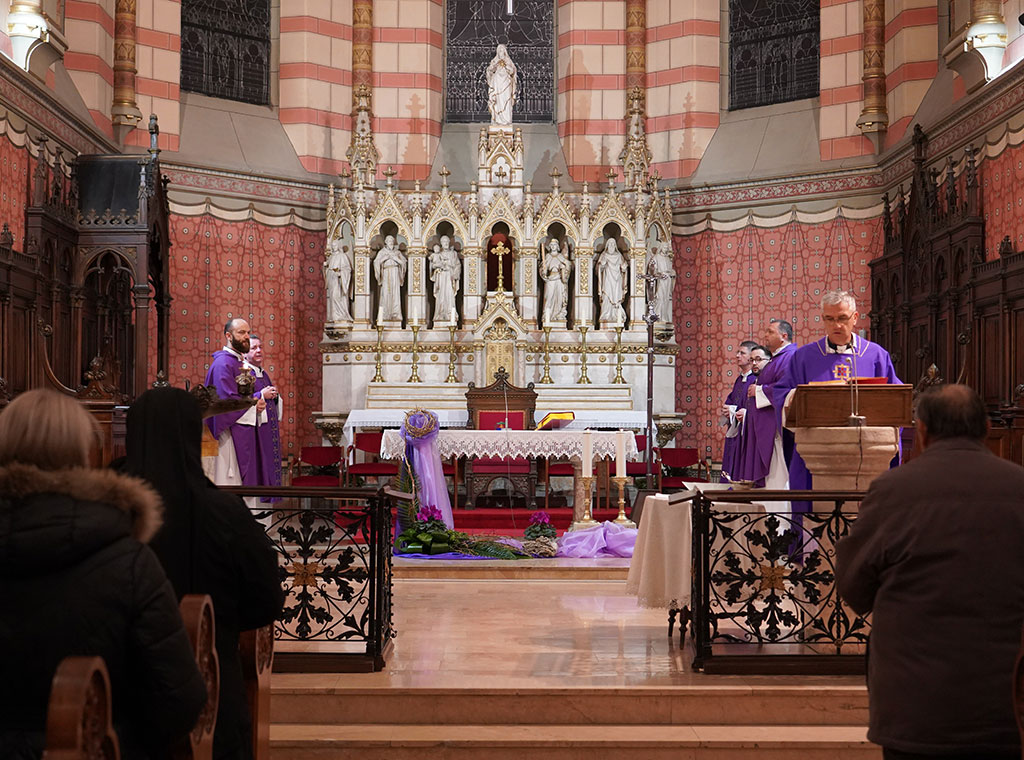
Therefore, this period is characterized by special liturgical elements that are an encouragement and help to believers...
The Lenten period (Quadragesima) lasts from Ash Wednesday to Maundy Thursday, i.e. until the Holy Mass of the Lord's Supper, which begins the Easter Triduum. That's a total of 44 days. However, given that the Lenten fast excludes Sundays, of which there are six in Lent, we arrive at the number 38. Two more days are added to them when Catholics fast - Good Friday and Holy Saturday, so there are a total of 40 days on which believers prepare for Easter by fasting.
The symbolic number 40 can be obtained in two other ways:
- counting all days (and Sundays) from Maundy Wednesday to and including Palm Sunday, which begins Holy Week, and
- also, if one observes the period from the beginning of Lent to the Easter Vigil - including, therefore, the Easter Triduum (Thursday, Friday and Saturday), which is a total of 46 days, from which the number six is subtracted, which indicates the six Sundays in Lent.
Therefore, the number of 40 days is viewed more symbolically and is based on biblical typology: the general flood lasted 40 days (Genesis 7:14); Moses stayed on Mount Sinai for 40 days (Exodus 24:18); The Israelites wandered in the desert for 40 years (Joshua 3:4); Elijah went to Mount Horeb for 40 days (1 Kings 19:8); Nineveh had 40 days to convert (Jonah 3:4); Jesus spent 40 days in the desert (Mk 1:13; Mt 4:2; Lk 4:1) and ascended to heaven 40 days after the resurrection (Acts 1:6-11).
Fast and fasting
At the very beginning of Lent - on Ash Wednesday, fast and fasting are obligatory for believers, as well as on Good Friday. So there are only two days a year when the Church obliges to do so.
Fast, briefly explained, would be abstinence from food. During fasting days, Catholics are allowed to eat their fill only once a day. It is mandatory for everyone from 18 to 60 years of age.
Fasting, on the other hand, is abstinence from meat and meat products. It is obligatory for all believers from the age of 14 until death. One is supposed to be fasting every Friday of the year.
During Maundy Wednesday and Good Friday, the believer takes only one full meal because of the fast and does not eat meat because he is fasting.
Pregnant women, nursing mothers, the sick and those who engage in heavy physical work are exempt from fasting (as needed).
Ash
Also, during Ash Wednesday, the forehead or crown of the believer is sprinkled with ashes (or the sign of the cross is made) while saying the formula: "Repent and believe in the Gospel" (Jesus' programmatic proclamation) or "Remember, man, that you are dust and will return to dust" (the words are reminiscent of the expulsion from paradise).
According to Adolf Adam's handbook Celebrating the Church Year, the regulation to burn palm branches from the previous year in order to obtain ashes first appeared in the 12th century. Later it was confirmed in a new missal, that is, it mentions ashes from olive branches that were blessed in the previous year.
Palm trees, olive trees, or sometimes yew tree twigs are carried on Palm Sunday and symbolize the joy of Jesus' solemn entry into Jerusalem.
Lenten colors
Purple is the colour of Lent, and it represents humility and penance. It is also used in Advent and is the same colour as the stole that the priest wears during confession. It symbolizes mourning, representing the pain and suffering of the crucifixion.
In the time in which Jesus lived, dark purple was a royal colour. And since he was mocked as the "King of the Jews" during his torment, they wrapped him in crimson (scarlet cloak), which is interpreted as a cloth of bright red-purple colour (Mk 15:17-20; Jn 19:2).
In the same way, in some churches, flower arrangements are not displayed during Lent, and on the Fifth Sunday of Lent - Deaf Sunday, images and crosses are covered with purple cloth, and the bishops' conference makes a decision on this if it considers that this custom for its area is worth keeping. If they are covered, the crosses remain that way until the end of the service of the Passion of the Lord on Good Friday, and the images until the beginning of the Easter vigil.
Also, on the Fourth Sunday of Lent, also called Laetare (because of the entrance song that calls for joy and the congregational and gift prayers that are shaped by the joy of Easter), the priest wears pink.
Devotion of the Way of the Cross
In the Church of the Croats during Lent, an important element, we can say indispensable, is the devotion of the Stations of the Cross, which takes place every Friday, and sometimes on other days.
It has its roots in the devotions of 4th and 5th century, when special places of Jesus' Passion were honoured in Jerusalem; while it developed into the form we have today in the 12th century, that is, in the time of the Crusades. In Europe, it was particularly promoted by the Franciscans. The final form of the Way of the Cross was established in the 18th century by St. Leonardo Portomauritian.
Initially, it consisted of a series of wooden crosses placed at intervals on the inner walls of the church (first seven, and later 14 stations). In the late Middle Ages, individual stations began to be built in the form of paintings, reliefs, stone sculptures or chapels in the area around the church or along the access roads (Calvary).
The traditional form of the Stations of the Cross is as follows:
1. Jesus is condemned to death.
2. Jesus accepts the cross.
3. Jesus falls for the first time under the cross.
4. Jesus meets his mother Mary.
5. Simon of Cyrene helps Jesus carry the cross.
6. Veronica hands Jesus a handkerchief.
7. Jesus falls a second time under the cross.
8. Jesus comforts the women of Jerusalem.
9. Jesus falls the third time under the cross.
10. Jesus is undressed.
11. They nail Jesus to the cross.
12. Jesus dies on the cross.
13. Jesus is taken down from the cross.
14. They put Jesus in the grave.
At the end of each station, the believers stop, pray and thinks about the theme that each station carries.
Penance
We come to the penance that is characteristic of the season of Lent, but it should not be connected exclusively to it, but should extend throughout the year because it helps in the fight against the devil's attacks.
The Latin translation of paenitentia means sincere repentance, change of mind, mentality, bad life attitude, it means getting back on the right path, making amends and giving satisfaction to God for committed sins.
We also have Jesus' invitation: "If you do not repent [do penance], you will all perish" (Lk 13:5).
From the very beginning, the Church has valued Lenten penance, spreading the spirit of penance, which was initially a harsh and demanding regulation.
As the late priest of the Diocese of Varaždin, rev. Krunoslav Pačalat wrote: "Christian penance shows the acceptance of the transience of this world: those who enjoy this world as if they are not enjoying it, because the form of this world is passing away. That is what St. Paul tells us in the Epistle to the Corinthians. Penance is joining Christ's suffering. With it, we atone for our own sins and accept the transience of the world. In the Middle Ages, they even flogged themselves in the name of penance. Over time, the penance softened a lot. Today it is even ignored and suppressed. Church regulations on penance are reduced to a minimum today. But in recent times, penance has been emphasized again. The value of penance is rediscovered. Especially its value for Christianity is being rediscovered. In the Church, there is awareness and faith about this value. Namely, the fundamental mission and proclamation of the Church is conversion. Almost the entire gospel is a call to repentance and conversion. The Christian life should be a life of penance. Even at baptism, a person is directed to penance. Even then, we were called to fulfill God's commandments. In penance, the penitent chastises himself (...) he looks critically at his life. He wants to improve and change."
Pope John Paul II. however, in his exhortation Reconciliation and Penance, emphasizes that penance is something true and effective only if it is carried out in acts of love. From this point of view, in the Christian vocabulary, it means a permanent and daily human effort, to lose one's own life for the sake of Christ. Mortification is good only if it serves love - for others and if it conforms us to Christ.
Alms
According to the Holy Scriptures and Christian tradition, in addition to the sacraments, there are three other privileged means of salvation and sanctification: prayer, fasting and almsgiving.
Father Mijo Nikić wrote that almsgiving, that is, acts of love and mercy done to those who are in trouble, according to Jesus, lead directly to the kingdom of God. "It is the royal way of salvation. The Bible recommends this in both the Old and New Testaments. So in the book of Tobias we read: "Alms frees from death, it cleanses from all sin" (Tob 12:9). Daniel tells King Nebuchadnezzar: "Therefore, O king, let this advice please you: atone for your sins with righteous deeds and your iniquities with mercy to the poor" (Dan 4:24). The wise Sirach also tells us that almsgiving destroys sins: "Just as water extinguishes a raging fire, so charity cleanses from sin" (Sir 3:30). Saint Peter the Apostle gives us wise advice and a golden rule: 'Above all, have ardent love for one another; because 'love covers a multitude of sins' (1 Pt 4:8)", states Father Mijo.
Fast and don't break it, sprinkle yourself with ashes, dress in purple, look at the Stations of the Cross, do penance and give alms - let these Lenten steps become our program so that after every "Good Friday" of our lives, we know that Resurrection Sunday is coming.
.jpg&w=420&h=235&zc=1&hash=e106aa4c03620f401d3905d5651c685a)


