
Three decades of an almost forgotten crime
čet, 11. siječnja 2024. 15:17
On January 9th, 1994, forces of the Bosniak Army of Bosnia and Herzegovina attacked the hamlet of Buhina Kuće in the village of Šantići, municipality of Vitez, killing 25 inhabitants and captured members of the HVO. Part of the civilians were released, the rest were taken to Zenica, and the defence of Lašva Valley was threatened with a general collapse...
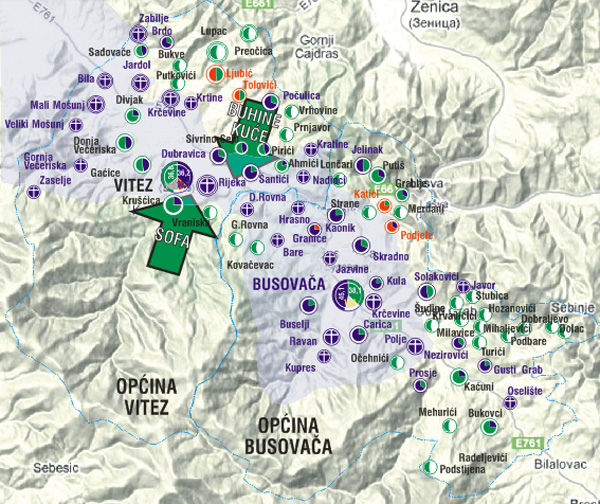
The chronology of the most important war events in the Lašva Valley says that in December 1993, the fiercest battles between Croat and Bosniak military units were fought for Križančevo Selo. It was in this place on December 22nd that the Croatian defence lines were breached and one of the biggest single crimes in the last war in Bosnia and Herzegovina was committed during active combat. A total of 63 Croatian civilians and HVO soldiers were killed, and by engaging all available forces, the unification of Bosniak troops in Stari Vitez and outside the city was prevented.
It was the beginning of the end...
Only 18 days after that crime, this time a few hundred meters to the east, while the wounds from Križančevo Selo were still fresh, on January 9th, 1994, a new horror happened to the Croats in the completely surrounded and blocked Lašva Valley.
That day, in the early hours of the morning, under the cover of darkness and fog, members of the elite units of the BiH Army and the MUP managed to penetrate through the defence lines and break into the Buhine Kuće and massacre HVO members and civilians. 25 soldiers and prisoners and civilians were killed and massacred, among them were women, old people and children.
To make the disaster worse, the road Vitez - Busovača was cut off with this attack, and the ultimate goal of the Bosniak attack was to connect with Vranjska, less than 1 000 meters away from Buhine Kuće, and thus cut the Lašva Valley in two, which, according to experts and military analysts' estimates, would also be the beginning of the end of the defence of the Lašva Valley.
In order to succeed in this, the Bosniak troops simultaneously attacked the Croat defence lines in several other places in the territory of the Vitez municipality. Stopping that breakthrough attempt was paid with another four dead and 15 wounded. Prominent members of the HVO, members of the command of the Third Battalion of the Vitez HVO Brigade, were also killed in these battles in the area of Sofa: Dragan Grabovac Galeša and Željko Matković.
Hope was restored in mid-February 1993
The Bosniak forces did not succeed because on February 14th, after daily battles, members of the HVO liberated Buhine Kuće, when the extent of the terrible crime of January 9th was finally fully seen.
It is important to point out that in previous battles for the defence of Buhine Kuća and in the battles for the liberation of this suburban settlement of Vitez, 9 members of the HVO were killed, and several dozen were wounded. In the fighting for the liberation of Buhine Kuće on February 14th, a prominent commander Major Jozo Plavčić, was seriously wounded, and a day later in the Franciscan Hospital, Dr. fra Mato Nikolić in Nova Bila, he passed away.
With the liberation of Buhine Kuće, the fighting in the Lašva Valley was reduced to a minimum, at least compared to December and January. Both sides were exhausted in the conflict, the end of which was not in sight at the time. The Croatian Defence Council (HVO) held its own despite the numerical superiority of the ABiH, which was no longer in a condition for serious attacks in that area. It seems that the Bosniak politicians also understood that the military struggle with the Croats in Central Bosnia no longer makes sense, and that victory over the HVO is impossible.
The logical sequence was the signing of the armistice, in Washington, just one month later, on March 18th 1994, when it was agreed to form the Federation of Bosnia and Herzegovina with 10 cantons...
The fight was fierce
We talked about this terrible crime and a turning point in the Bosniak-Croat conflict with Zvonimir Čilić, a member of the HVO Vitez Brigade Command at the time, who was on duty at the headquarters quite by chance on the night of January 8th-9th 1994.
By the way, Mr. Čilić was educated in Vitez, Sarajevo and Ljubljana. He is a social worker by education, and by profession he is a journalist and publicist, and co-founder and first editor-in-chief of Radio Station Vitez. From the first day of the last war, he was included in the HVO, and before and after the blockade of Lašva Valley, he was on the front lines against Serbian forces, among them Kupres and Glamoč. He is the author and co-author of several books and publications, among them Viteške ratne kronike (Vitez’ war chronicles), the photo monograph Svjetlost I nada: Bijeli put I bolnica u Novoj Biloj (Light and Hope: The White Road and the Hospital in Nova Bila)...
Unfortunately, at the beginning of the conversation, he said about Buhine Kuće that they were once forgotten and he does not remember the special anniversary when the political leaders of the Croatian people came to mark the day of this crime. He says that lately there have been initiatives "from below", from the soldiers themselves from the field, so that the commemoration and remembrance of this event is returning to the public.
"After the fall of Buhine Kuće, the road was occupied, but not the connection between Vitez and Busovača. That is why the Muslim troops attacked fiercely to connect with their positions in Vranjska. If that line of Vranjska - Buhine Kuće had been connected, it would have been the beginning of the end of our fight for the Lašva Valley. I don't believe we would have survived", said Čilić, who pointed out that he is aware that the members of the units he calls Muslim are actually Bosniaks, but remembering 1993 and 1994, he emphasized that he would use the terminology of the time.
"Somewhere around 5:00 a.m. on January 9th 1994, the first news came that something was happening. It was very foggy and cold, as it can be in Lašva Valley. I immediately called the commander Marijo Čerkez and we got together. In the meantime, the shooting started, a horror. We did not give special orders except to fight, stay and survive. We had no other options, our families were in Vitez and Lašva Valley. Behind my back were my mother, wife and minor daughter. We all had our loved ones behind us and then we turned out to be heroes, but we weren't. You know what people say, when you force a cat, it runs away, if you corner it, it scratches. We were squeezed so that we had nowhere to go and we scratched and fought. We lost and returned individual parts. It is a small territory and the loss of one hamlet means a lot. A little while ago, the Bijeli put (White Road) broke through, which brought us new strength, not in weapons, but in the idea that we are not alone", said our interlocutor, noting that "special units of the Muslim army and the MUP were the ones attacking.
"There are many elements that say that these were Dragan Vikić's units. I can't decisively claim that, there are records, some processes are being started, so we'll see if it's true. Then we will know if 'our' Golden Lily and his team participated in the massacre in Buhine Kuće. So far, no one has been convicted of this crime", added Čilić, who spends his retirement days extremely actively, especially on the Vitez-Zagreb route, where his daughters live.
"With the liberation of Buhine Kuće on February 15th, a big burden fell from our backs. Then we were convinced that we were staying here. It was constantly 'hanging' whether they would cut us or not. We took a break then, and we couldn't rest until the Washington Agreement, but we knew we survived", he asserted and added that he was glad, as were many of his friends, that today Croats and Bosniaks who escaped live together in one Vitez or were exiled.
He then compared that return with the process of returning Croats to Travnik, when there were also dead people. "There were no murders of returnees in Vitez. Today, life is normal, Buhine Kuće have been restored, people who survived the war have returned", said Zvonimir and emphasized that since the last war, journalists often asked him, especially those from Croatia, why there were strong and constant attacks on Vitez.
"Those who know something about the former Yugoslavia are aware of the military industry in Bugojno, Novi Travnik, Sarajevo and Goražde. The Muslim side was missing Vitez and former Explosives Factory Slobodan Princip Seljo. If they won Vitez, then they would have 80% of the military industry of the former Yugoslavia. We knew something about those explosives and rocket fuel, so somehow we stayed and survived", he explained to us the fierce attacks on Vitez and the 316 days of the blockade.
Towards the end of the conversation, we touched on the importance of Buhine Kuće for the future, which is reflected in the desire for peace: "I say God forbid this happens to anyone, never and nowhere." This is my wish and ours, but, unfortunately, these wishes are not fulfilled because every day somewhere in the world there are "roars", killings and perishing. You have to experience that, and killing of friends and acquaintances, and then know how to say: God forbid, to anyone."
Explaining that his father disappeared at the end of the Second World War and that he does not know the grave of the other seven members of Čilić family, and speaking of the terrible partisan crimes in 1945, he pointed out that the first archbishop of Vrhbosna, the servant of God Josip Stadler, chose Travnik for the Archbishop's Seminary because of the analysis that Lašva Valley is the most Croatian part of Bosnia. He emphasized that the partisans knew this when they committed major crimes in Travnik and the surrounding area.
"We are now more than halved numerically, but somehow we still don't give up. It was similar in the Second World War. There were killings was banishing. We suffered in this war too. Vitez alone had 653 dead and murdered people, and this is a small town. "By percentage, after Vukovar, Vitez has the most victims among Croats in Croatia and BiH", said Čilić at the end and added that the economy, culture, and even sports are still strengthening: "We don't give up, we go forward, we say we have to fight, then, dear God will also give."
Troubles on the monument
During the conversation with Mr. Čilić, we touched on the issue of the monument in Buhine Kuće. Since he did not know when it would be built, we contacted the parish priest OFM Velimir Bavrka, who directed us to Josip Buha. The general public heard about him in the media if they followed the pilgrimage from Vitez to Vukovar organized in recent years by the Association of Pilgrims of the Blessed Alojzije Stepinac. The President of that Association is the retired Josip from Vitez, who with this pilgrimage wants to show respect to the Hero City, but also to point out the numerous victims that the Croatian people in BiH had in the last war.
As we found out in our conversation with him, thinking about what should be done so that Buhine Kuće are not forgotten, and seeing that no one has done anything for 27 years, neither the associations that emerged from the war nor the politicians, he came up with the idea of building a monument. Three years ago, he submitted documentation to obtain a building permit, that is, urban approval for the construction of a memorial.
"I submitted the documentation, but I never received a confirmation that the request was received, or that they told me if I was missing something from the documents. I also addressed the Joint Commission for Memorials in the Municipality of Vitez. I never got any answers. You know when a person revolts... so we started doing earth and concrete works in February 2022 and for that I paid a fine of 500 KM. I was supposed to pay 1 000 KM, but in the end it turned out to be half the price", Josip told us, pointing out that the cross was finished and the angel wings on it, but because of advice and threats and blackmail, everything was slowed down.
He emphasized that without urban approval, he cannot get funds for further construction, and the inspection is waiting. Part of the land at the place where the monument was built was donated by Nedeljko Vidović, son of murdered parents Dragan and Ankica. His uncle Mirko Vidović was also killed there, as was Mirko's son Dražen Vidović. Nedeljko himself was the most seriously wounded person who was transported to Split and barely survived.
"The problem with the construction of the monument lies in political manipulations. We heard that the SDA wants the naming of the street or the square of Alija Izetbegović as a return service. Alija has beaten and attacked Vitez, and now there should be a street or a square for him... That love is not going to happen, Alija's street will not exist, but there will be a monument", said this former HVO member who on January 9th held a position on the other side of Vitez. However, today he lives in Buhine Kuće with his second wife Lenka Lucija Šantić, since his first wife died three years ago. He emphasized to us that he had received "instructions" not to place the cross on the monument yet, but during Advent, a Christmas tree was placed on the platform.
More could be written about the crime in Buhine Kuće. The extent of the horror that it represented can only be understood by those who were in the surroundings of Vitez during those long 316 days, as well as relatives, neighbours and friends of those who died. While we remember the sadness and loss in that region, we must not forget that the light of God's justice has the power to illuminate even the darkest corners of the human past. Let this story, as well as the struggles of building a monument and finding the perpetrators and direct executors of the massacre, be a reminder that earthly justice must not be just an abstract concept, because that is not how a path to a better future can be built.
.jpg&w=420&h=235&zc=1&hash=e106aa4c03620f401d3905d5651c685a)


