
Three decades since the crime against Croats in Grabovica
ned, 10. rujna 2023. 10:01
The Archbishop of Vrhbosna, Msgr. Tomo Vukšić celebrated the Eucharist at the cemetery in Grabovica, which belongs to the parish of All Saints in Drežnica, not far from Jablanica, marking three decades since the massacre of Catholic Croats there.
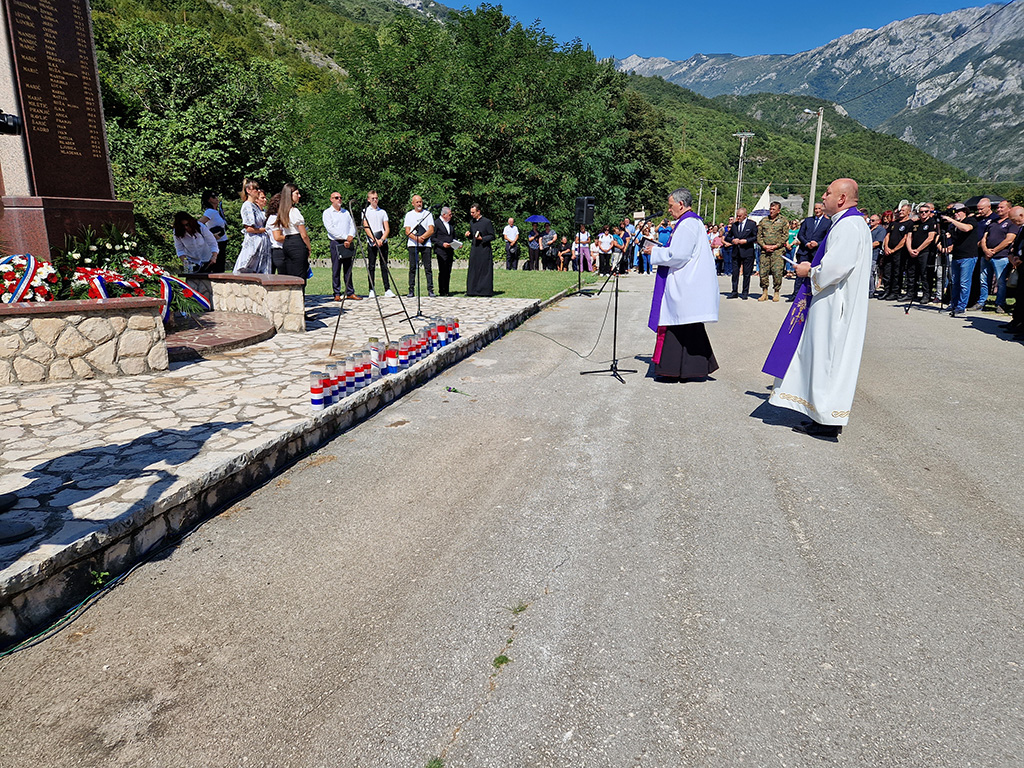
The program marking this sad anniversary began with the laying of wreaths at the monument to the victims of the last war in Grabovica, where the president of the Association of Croatian Victims of Grabovica '93, Josip Drežnjak, addressed the present.
After the speech of the President of the Association and the prayer for the dead, those present headed to the local cemetery, praying the Way of the Cross. After arriving at the cemetery, the Holy Mass was celebrated by the Metropolitan Archbishop of Vrhbosna and the Apostolic Administrator of the Military Ordinariate in Bosnia and Herzegovina, Msgr. Vukšić. About 10 priests concelebrated, among whom was the administrator of the parish in Drežnica, rev. Drago Ćurković.
The souls of the dead await the resurrection of the body
In the appropriate homily, which he titled, May it never happen anywhere, never and to no one again!, the archbishop pointed out that three decades have passed since in this canyon of clear water, the malice of clouded human minds, violently and in a very violent way, took the lives of unprotected civilians.
"And many times until now, especially on the occasion of commemorating this tragedy, in Grabovica and in other places the names of the victims have been repeated and the words, sighs and tears of their relatives and friends have been recorded. During that time, numerous wreaths were laid at the foot of the monument, which are the ex
Stay in the faith
He further explained that Catholics believe that this is precisely the basic message of these victims and of every similar tragedy anywhere else. "We believe that all the victims of war violence who lost their lives throughout Bosnia and Herzegovina want and pray that our future will be better than their past. Based on historical experience, it is known that fair laws and their consistent application make a very important and decisive contribution to the establishment of justice, social harmony and the maintenance of peace between people, nations and countries", he added, emphasizing: "The Christian faith teaches us that lasting peace with others it begins to build for people at the moment when a person aligns their own life, thoughts and behavior with God's rules and thus establishes a covenant of peace first with the Lord God, from which peace in his own conscience emerges."
He emphasized that Christ, by his example, is a model of peace because in him every possible distance between God and man has been overcome and every presence of evil has been erased.
Then he reflected on the fact that reconciliation with God is the first and most important stage in building any other form of harmony, peace and friendship, and at the end of the sermon he invited those present to remain grounded in faith and constant and unwavering in the hope of the gospel that is preached to every creature under heaven, and proud and faithful ministers of the peace of Christ.
Anatomy of a crime
Let us remind you that this war crime took place on the night of September 8-9, 1993, when members of the BiH Army brutally killed 33 innocent civilian victims. There were no military operations there, nor HVO soldiers, so the crime is even more horrific.
Bosniak soldiers entered Grabovica and occupied it militarily on May 10th, 1993. Four months later, they killed 33 Croatian civilians. The youngest victim was four-year-old Mladenka Zadro, and the oldest was 87-year-old Marko Marić. During the summer, one man was killed in Ćopi, in a neighboring village down the Neretva, and then, on September 9th, 1993, 27 mostly elderly people and a four-year-old girl were killed. Two days after the bloody feast, two more people were executed, again in Ćopi, and a little later an old man was killed in the village of Kremenac. That's a total of 33 Croatian civilians.
Some victims were buried near their homes, and most were thrown into the Neretva. Unfortunately, only one two-member family was saved from the right side of the Neretva and seven people from the left side.
It is important to point out that at that time no fighting took place in the vicinity of that place and that none of the Catholic Croats in that area were armed.


.jpg&w=420&h=235&zc=1&hash=e106aa4c03620f401d3905d5651c685a)


