
Joint Statement on the Occasion of the 1 700th Anniversary of the Council of Nicaea
sub, 08. studenoga 2025. 08:37
At the KBF in Sarajevo on November 5th, at the beginning of the international symposium on the 1 700th anniversary of the Council of Nicaea, the Archbishop of Vrhbosna, Metropolitan Msgr. Tomo Vukšić, and the Metropolitan of Dabrobosna, Hrizostom, signed the Joint Statement.
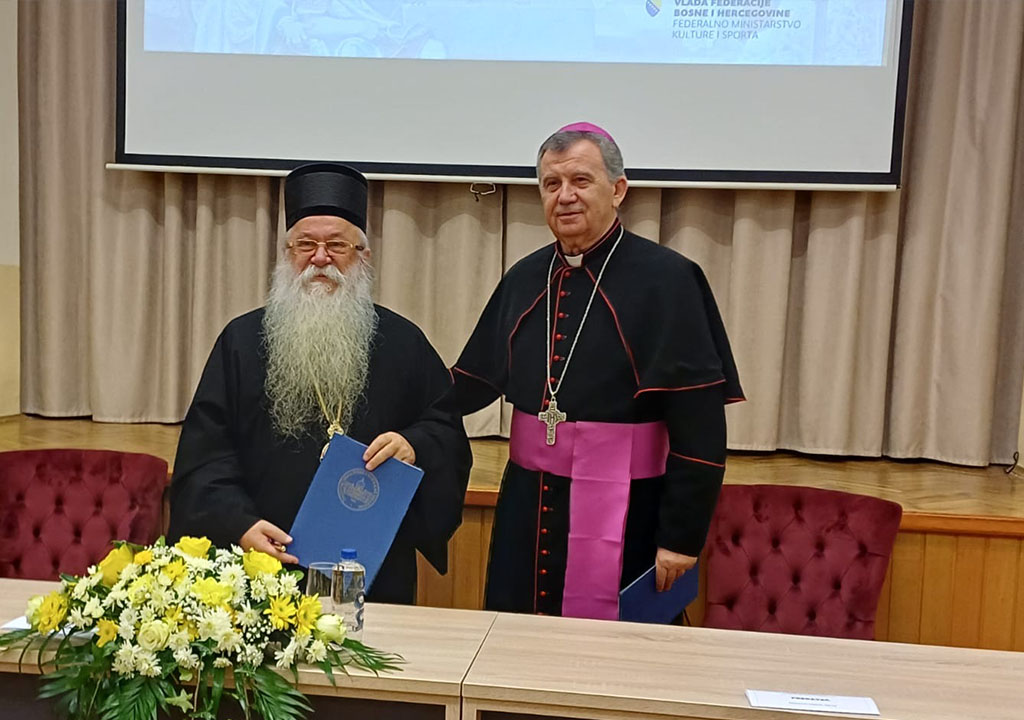
PHOTO KBF Signing the Statement: The Fight Against the “Aryans of Today” Continues
We present the statement in its entirety:
1. The Lord, the good Providence and generous Shepherd, has given our generation the honour, but also the obligation, to celebrate a great jubilee – seventeen centuries since the day when Christian bishops, theologians, and priests gathered in Nicaea, Asia Minor, today's Iznik, for the First Ecumenical Council. It began a new era in the life of the Church of Christ, and the heirs of that era and that council today are all Christians who remember with holy love this significant event, a kind of turning point in the life of the Father's House and the Body of Christ. Therefore, we consider it our duty to first return to that time with our minds and hearts, and then to ask ourselves: how is the Council of Nicaea reflected in our present day and in the world around us?
2. 1 700 years ago, on the outskirts of Constantinople, which was still an imperial construction site, in ancient Nicaea, whose very name announced the victory of Christianity, more than 300 bishops gathered for a council that would begin the era of ecumenical councils. The reason for the council was not small: the Alexandrian priest Arius first excited his local Church, and then the entire world of that time, with his erroneous teaching about the Son of God. Although he lived an ascetic life and was popular among the early monastics and the people, Arius waged war against what was then and is today the most important belief of Christianity – against the biblically confirmed and apostolic Tradition-established teaching about God as the true and eternal Father of his Son and Wisdom (John 1:1).
Many theologians have since investigated the causes of Arius’ heresy. Was this what he taught from his teacher, the presbyter Lucian of Antioch, himself prone to misinterpretations of the Holy Scriptures, but less persistent than his disciple in his efforts to convince others of his delusions? Or was the cause a mistaken vision of monotheism in which there was no room for the most important thing that was revealed and confirmed to us in Christ – for the Good News about God as the eternal interpenetration of the Father, His Son and His Holy Spirit? Or was Arius misled by erroneous and abstract philosophical teachings about God as an impersonal One, who can never be in a true relationship with anyone else? Whatever the reason, Arius’s teaching that the Son of God, Christ, was not the true Son, but only the first creation, stirred up the spirits in Alexandria. The good shepherd and wise theologian there, Bishop Alexander, tried to explain to Arius the absurdity of his understanding, pointing out that the Holy Scriptures call Christ “the radiance of the Father’s glory and the exact blueprint of His being” (Heb 1:3), but the proud presbyter would not listen to his bishop. And not only did he not respond to the call to repentance, but he began to gather all those who wanted to reduce the Good News of Christianity to speculation about the One who does not and cannot give birth—to fables about Christ who is not really the Son, about God who is not the Father, and about the Holy Spirit who, according to Arius, is only the official power of that One.
This was a time when the holy Church of Christ had just experienced its first years of peace thanks to the pious Emperor Constantine and his conviction that for the good of every state it was necessary that all people, including Christians, should have lasting peace and security. The ink on the imperial signature of the Edict of Milan in 313 had not yet dried, the martyrs who had confessed their faith during the terrible persecutions of Diocletian were still showing their wounds, the ruined churches were just beginning to rise again – and already around 318 Arius had disturbed the Church with his impudent heresy.
As the matter had assumed proportions that encompassed the entire inhabited world (even areas beyond the borders of the Roman Empire), it was necessary to convene such a council at which all the bishops from all over the world would meet in one place and testify to the true faith. The emperor himself understood that this was both his concern and the concern of his state. He sent invitations to all four corners of the world, and indeed, from all sides – from Spain to Persia, and from present-day Germany to southern Egypt and Sudan – bishops, 318 of them, came to the old city of Nicaea, not far from Constantinople, which was being built around 324. Nicaea was located near the sea, but right on the shores of Lake Ascalon, almost in the centre of the world at that time, equally distant from the most distant points of the Church, whose word had already spread beyond the borders of the Empire. The council began in May and lasted until July 325.
Ecumenical councils are living events in which the work of the Holy Spirit is manifested through the theology of the council Fathers, and not boring administrative procedures. Even today, just getting to know the work of that council inspires us. Tradition mentions an episode with St. Nicholas of Myra, who, even physically, opposed the madness of Arius. The Fathers then rebuked him for the way he defended the faith, but they praised his zeal in defending piety against impiety and shamelessness.
The records testify that the struggle for orthodoxy was difficult and persistent. The Orthodox Fathers found verses in the Holy Scripture that opposed Arius’ error, emphasizing that Christ is the Power of God, the Son of God, and the Word of God. However, the Arians twisted every one of their biblical claims and cunningly interpreted it in the opposite sense. Then the Fathers decided to supplement the text of the confession of faith of the Church of Caesarea, which was their template for the Nicene Creed, with ex
3. What is the significance of this council of the God-inspired fathers in Nicaea today? So much so that it cannot be overemphasized. Not only did the Fathers of the council accurately and far-sightedly determine the standard of basic Christian orthodoxy, but they showed us the path of conciliarity, the path of gathering, the path of universality of the Church as the way in which the Body of Christ responds to the challenges of the times. Although we live in a different era today, the concern to find theological answers to doubts and unrest remains the same.
Today's times are significantly different from those of 1 700 years ago: many Christians, especially in Europe, forget the Nicene, Christian roots of theirs and our civilization and live completely indifferent to the faith of the Nicene Fathers. The great crisis in which the dogmas of Christianity are spoken of with misunderstanding or open contempt shows the depth of the abyss in which today's European civilization finds itself. If St. Gregory of Nazianzus complained 1 700 years ago that in Constantinople of his time theological issues were being discussed in the markets and baths, today we live in a civilization in which many so-called liberal Christians, including some preachers, sadly but openly speak of the “obsolescence” of Christian teachings and the dominance of the Christian ethos.
Therefore, we ask ourselves: how and when can the teaching that God is the Holy Trinity, that He is the eternal and unconditional love of the Father, the Son, and the Holy Spirit, that God loved the world so much that He gave His only begotten Son to be a Sacrifice offered for the life of the world, become obsolete? When and how did the understanding that man has dignity because he was created by the Triune God cease to be important? When and how did it become unimportant to believe in a God who became man so that man could be “deified”, to become a little god by grace? And what can a civilization hope for in which Christianity is at best an old cultural heritage, and often not so much? Is the state of chilled love, moral indifference, the increase in abortions and suicides simply the result of forgetting the Nicene Creed? Has not a civilization in whose centre the God-man is no longer located reached its absurdity – because every day we fear a nuclear apocalypse and see thousands of people dying due to wars, lack of love, abortion clinics and euthanasia? Is not the price of forgetting the Nicene Creed too great for humanity, especially for once Christian Europe – southern, northern, eastern and western? We think and say that it is. We think and say: the jubilee of 1 700 years of the Council of Nicaea should warn us and teach us to turn once again to faith in Christ Jesus, in His Father, the giver of all good things, and in the Holy Spirit who gives life and raises us up.
This jubilee should be a call to change and repentance, to the renewal of Christian impulses in us and in the people around us. We are called to bear witness to this faith through active care for those for whom Christ was crucified – and that is every neighbour, every human being, unborn and born, because every person is created in the image and likeness of the triune biblical God (Genesis 1:16).

.jpg&w=420&h=235&zc=1&hash=bfa7d2c3c6d2fc4282187f8a3ace1b12)


