
Msgr. Philippe Jourdan
Catholics of the Baltic States will gather together as a family around the Holy Father
čet, 20. rujna 2018. 10:36
Pope Francis will be on his 25th apostolic visitation outside of Italy from 22nd to 25th September. On this occasion he will visit three Baltic countries: Lithuania, Latvia and Estonia.
Interviewers: Dražen Kustura/Reena Tolmik
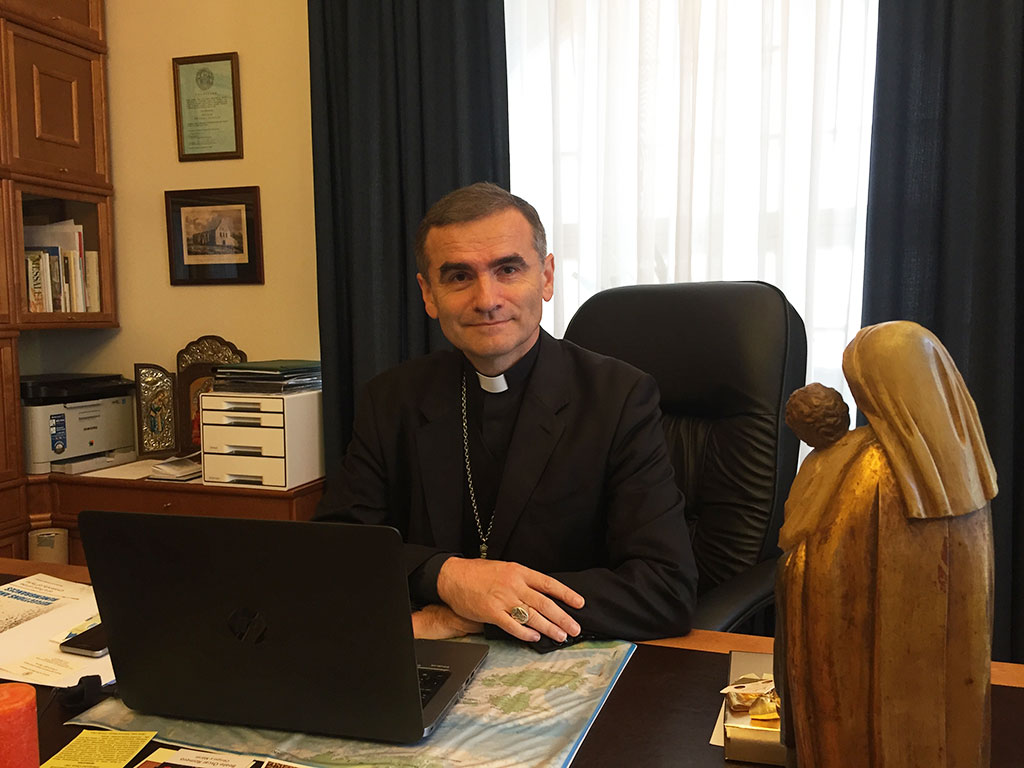
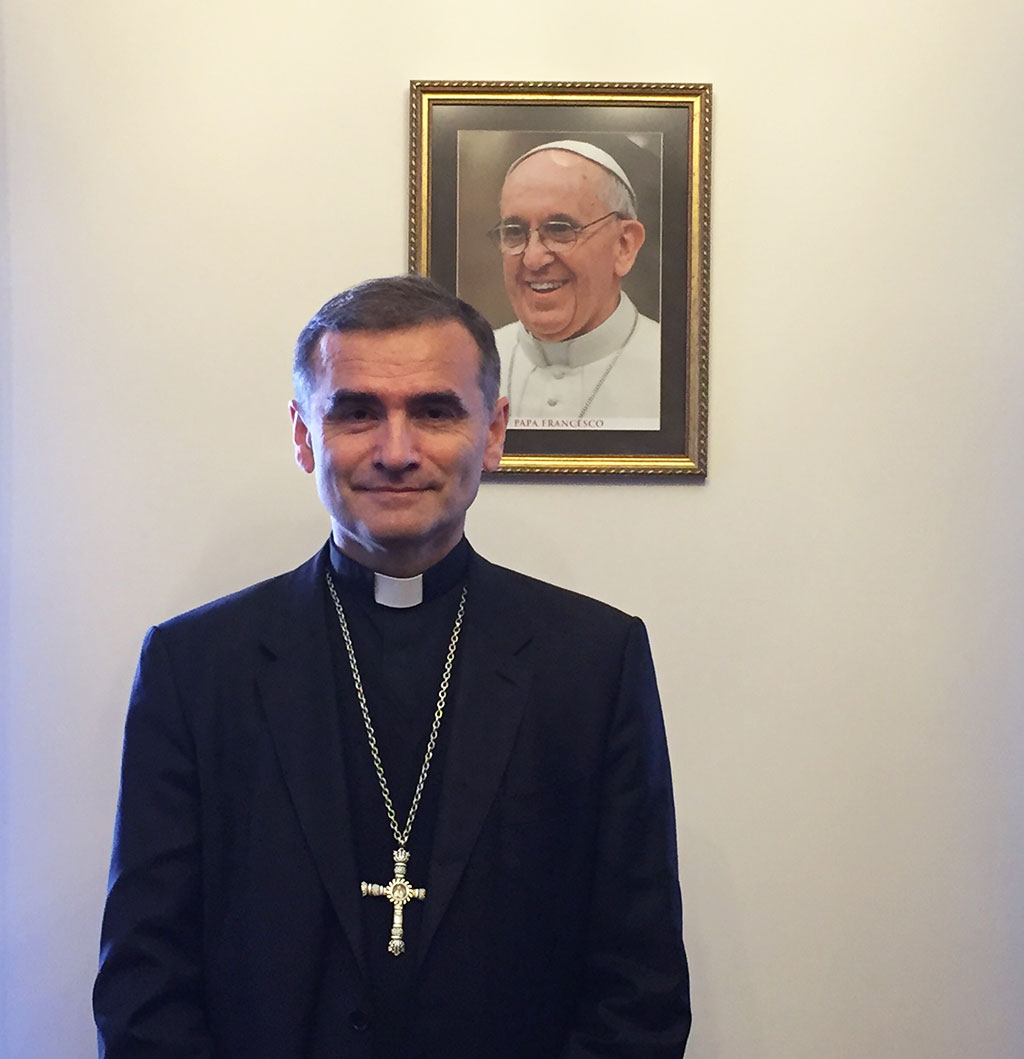
In what kind of spirit are these Baltic countries welcoming the Holy Father, but also about the life of Catholic Church in this part of Europe, we talked to Msgr. Philippe Jourdan, Apostolic administrator of Estonia.
Msgr. Jourdan was born on August 30th 1960. in Dux, France, in a catholic family as the oldest brother of three, and one of his brothers is a priest too. After the studies of mathematics, he sensed priestly calling and finished theology in Rome on Pontifical University of the Holy Cross. At the moment he is finishing his doctorate in analytical philosophy. He was ordained a priest in 1988. and was incardinated in the prelature Opus Dei, whose member he is since 1980. He acted firstly as a student chaplain in Paris and he was actively involved in organizing of World Youth day. Since 1996., he acts and works in Estonia when he was named apostolic administrator, and from 2004. he is the vice-president of Estonian Council of Churches. Beside his mother tongue, French, he speaks six other languages: Estonian, Russian, English, German, Spanish and Italian.
Your Excellency, Msgr. Jourdan, soon the Baltic countries will be visited by Pope Francis. What does this visitation mean for Catholics in Estonia but also Lithuania and Latvia and are you ready for his visit?
First of all I think that it is a very great joy for everybody in the Baltic States and especially for us, because it is the first time since 25 years the Pope is visiting Estonia. I think that the visit of the Pope in Estonia is bigger challenge than the visit of the Pope in Latvia and Lithuania because the Pope in Estonia will meet with one of the smallest Catholic communities he has met with and one of the less religious countries where he has ever been. So in that sense it is a challenge indeed, but I think the Pope is of course very well aware of that and he likes such challenges.
This will be Pope's 25th apostolic journey outside of Italy. How is it specific and in what kind of climate Estonia, Lithuania and Latvia are welcoming the Holy Father?
I think it is specific in the sense that five years ago the Pope said that he would like to visit small countries who has to fight more than others to keep their place in the world. And he would also like to visit countries in which people have suffered much during the 20th century and it is clear that Estonia is in both categories. In that sense I think that the visit of the Pope in Estonia has another signification than the visit of the Pope for instance in the Netherlands or in Belgium or in Switzerland as it was in June. And of course, as we know the Baltic countries are now in a little bit of complicated international situation – also that is true. Perhaps we feel a certain tension everywhere with the world and Eastern Europe. I think the visit of the Pope is for all people in Estonia, not only Catholics, a very great encouragement.
In your opinion, what messages will Pope Francis send to people in these three countries?
Well, the question is not what my opinion is. The question is that in a few days the Pope should send his personal message to Estonia before the visit. I remember what the Pope wrote to Estonia three years ago when we renewed the consecration of Estonia to the Holy Virgin. He sent us a very nice letter which finished with the following words: I wish to all Estonian people and to all Estonians lively faith, strong hope and active charity. So I think in one way or another it is also the idea that the Pope will develop altogether with the motto of this visit to Estonia which is Mu süda ärka üles, that means Wake up My Heart – it is just what we are waiting from the Pope.
Pope Francis has so far visited countries outside of Italy where Catholics are either in a minority or in which there is great poverty, including our homeland Bosnia and Herzegovina in 2015. How much will this trip be encouragement to Catholics in Estonia?
The Catholics in Estonia are not only minority, but they are very small minority. Much more than in Bosnia and Herzegovina for instance. So, we belong to those countries where the Catholics live in extreme Diaspora – a few Catholics and all dispersed over the country. For that reason, since the moment I knew that the Pope will visit Estonia, I thought that this visit should be like a feast – not only for Estonian Catholics but also for all those Catholics who live around us and are in the same situation – live in the countries where there are very few Catholics where from the human point of view the Catholic church is almost insignificant. For that reason, I invited the Finnish Catholics, the Russian Catholics because we need, especially when we live in such situation, we need to gather as a family around the Holy Father.
On this journey as well, the Pope will meet with the representatives of the state authorities and the diplomatic congregation, but also the youth at the ecumenical meeting. How important is this meeting and what is interreligious and ecumenical dialogue in the Baltic countries like?
I think it is extremely important because of two reasons. First of all, because it will be the last public meeting of the Pope with young people before the beginning of the Synod on Youth on October 3rd. When the Pope will begin the Synod he will have in mind the experience of this meeting in Tallinn. The second reason is that it’s a real ecumenical meeting. It is not only meeting of the Pope with the bishops of other churches, like a diplomatic meeting as it will be the case in Latvia, Riga. But it is really young people from different confessions coming together and listening to the Pope and what he is saying. There will be witnesses of three young people: one Catholic, one Lutheran, and one Orthodox. So indeed in that sense I would say that it will be the main really ecumenical meeting during this visit in the Baltic States, because usually ecumenical meetings are really more a kind of diplomacy than really ecumenical. But in that case it will be not be a meeting with the bishops of other churches but meeting of Christians, young people from different confessions together with the Pope.
After St. John Paul II visited Estonia, Lithuania and Latvia in 1993., this will be the second time in history for the Pope to come to the Baltic States. How much has the circumstances changed in this country between these two visits?
It is what we wanted to express with the motto of this visit: Mu süda ärka üles – Wake up My Heart. 25 years ago when John Paul II visited Estonia he said in Estonia more or less what he said in other eastern European countries and other countries of Europe: “Don’t be afraid.” Because it was a time when there were still soldiers of the ex Soviet Union present in 1993. So it was a time when the Estonian State and society were only in the beginning to structure itself. So it was a time of great uncertainty. But on the other side it was also a time of great hope, expectations of universal peace and unity of Europe and so on. So it was time perhaps of great uncertainty, also poverty, and time of great hopes and ideals. 25 years later, I would say, Estonian society is much stronger, richer, and more stable; but perhaps those ideals and hopes are a little bit decreased. Instead of this there is great individualism, scepticism, and in that sense what we need now is not so much that somebody tells us “don’t be afraid” but what we need is that the Pope help us so that our heart wakes up.
Many in Bosnia and Herzegovina have a small knowledge about Catholics in Estonia. Can you tell us what the life is like of the Catholic Church in that country?
Well we are a very small community; there is a community of more or less 6 000 – 7 000 Catholics. In the beginning of 1990 there were more or less 2 500 members. In the beginning of 70’s there were about 5 or 6 Estonian Catholics. And then there were Germans from Siberia who were waiting to leave The Soviet Union. It’s the reality of the Catholic Church in Estonia which may be one of the youngest Catholic Churches in Europe in the sense that we had to begin from almost zero. It is also very nice that many Catholics here are converted and, in that sense, also have a great wish to know better the faith and live the faith, but in a certain way we are like the first Christians – not very visible but inside the society.
Continuing previous question, which are the greatest challenges that Catholics face?
First of all, the same challenge that the whole Church – the young people. I was really happy to see that in the beginning of April and May when I spoke with my Lutheran colleague and other colleagues about the youth meeting with the Pope, we were really afraid that we will never fill the Kaarli church with young people, because they told me: “No here it is Tallinn, it is not Warsaw, it is not South America. How will we fill the church with so many young people?” In the end, actually already since two months the church is completely full, there are more people wishing to come than the possibility to receive them. So it is a good sign but it is true that the faith of young people is in the centre of our preoccupation. The second challenge is the family of course. Many, many families here are dislocated or recomposed. It is the case of almost all countries in Europe but I would say that in Estonia it is more massive as in other parts; in the sense that what should be exception is actually a norm and what should be a norm is now more an exception. It is a great challenge.


.jpg&w=420&h=235&zc=1&hash=bfa7d2c3c6d2fc4282187f8a3ace1b12)
