
Scientific symposium Homage to Pope Benedict XVI.
pon, 13. studenoga 2023. 11:37
An international scientific symposium called Hommage to Pope Benedict XVI was held at the Catholic Theological Faculty of the University of Sarajevo on November 9th and 10th, and it is a traditional symposium organized by the Sarajevo KBF in November on current topics in the Church and society.
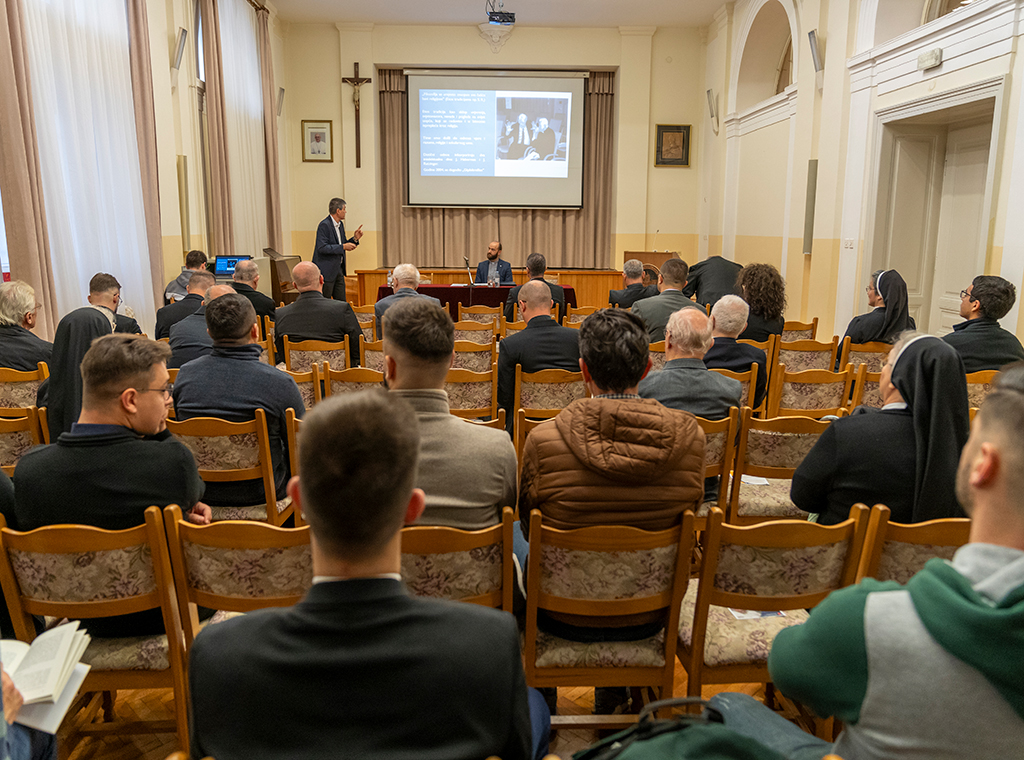
At the beginning, the archbishop Metropolitan of Vrhbosna and the great chancellor of the KBF, Dr. sc. Msgr. Tomo Vukšić greeted all present, who, among other things, said that during his lifetime Joseph Ratzinger proved himself as one of the most important Catholic thinkers of the 20th and 21st centuries. "He was, as some wrote about him a long time ago, a theologian capable of being clear like hardly anyone else (...) He connected old Christian authors with contemporary thought, the pastoral needs of the Church, science and the world, and spoke the language of this time to current people and culture, always directly, and sometimes polemically", said Msgr. Vukšić.
Then the Dean of the KBF, Dr. sc. Rev. Mario Bernadić, who moderated the first day of the program, in his opening speech briefly presented the life path of Joseph Alois Ratzinger.
Professional presentations
The greeting was followed by lectures. The first presentation under the title Elements of Joseph Ratzinger's theological thought was held by professor Ph.D. sister Valerija Kovač, assistant professor at the Department of Dogmatic Theology of the KBF, University of Zagreb, and on the first day of the symposium, two more lectures were held: Klaus Berger and Joseph Ratzinger for the future of exegesis, held by the professor of the Sarajevo KBF, Ph.D. Rev. Dubravko Turalija, and the lecture in the Slovenian language entitled The future of the Church will be shaped by the saints this time as well, which was held by Dr. rev. Janez Ferkolj, lecturer in the field of dogmatic theology at the Faculty of Theology in Ljubljana and parish priest in Bled.
The emphasis in the lectures was, among others, the connection between person, theology and service in Joseph Ratzinger/Benedict XVI, who did not create his own well-rounded thought system, but his theology is intellectually, temporally and thematically open: it starts from the contemporary issues of believers and the Church, man and society, respects the contributions of contemporary theological and other thinkers and reads Scripture and tradition in an up-to-date manner. His contribution to the future of exegesis is also strong.
A discussion followed the lectures.
Numerous lecturers
On the second day of the symposium, the program was moderated by Dr. Ljubo Zadrić, and it opened with a presentation Joseph Ratzinger and Jürgen Habermas in a thought confrontation, by professor of philosophy at the Catholic Faculty of Theology in Đakovo, Dr. Stjepan Radić.
The presentation Connections between Ratzinger and Augustine: the understanding of the Church in the thoughts of Joseph Ratzinger was given by the professor of patrology and Christian studies at the KBF in Đakovo, Dr. Drago Tukara. In the lectures, among other things, it was possible to hear about Ratzinger's view of the relationship between religion and society, that is, the Church and the state, and how he told the Church about what happened at the Second Vatican Council, "that it is Catholic in union with the Pope, in communion with the Eucharistic Christ , the Church is a mother, not a sister, as well as the fact that she is an instrument in God's plan of salvation".
A discussion and a short break followed, and the program continued with a lecture by professor Dr. sc. Antun Japundić, professor of ecumenical theology at the KBF in Đakovo, on the topic The importance of ecumenical and interreligious dialogue in the teachings of Joseph Ratzinger.
Presentations were also given by Ph.D. sc. Ivan Rako, professor of liturgy and church music at the Sarajevo KBF, on the topic Summorum pontificum of Pope Benedict XVI and Traditiones custodes of Pope Francis, and dean Bernadić on the topic Faith, hope and love in the eschatological thought of Joseph Ratzinger, and it was possible to listen to different approaches regarding the liturgical reform in the Catholic Church and the attitude towards the traditional liturgy, and about Ratzinger's eschatology, which emphasizes the Trinitarian dynamic as the key to understanding the final fulfillment of faith in the Christian context.
This was followed by a final discussion, which concluded the Homage to Pope Benedict XVI symposium.
It is worth noting that the holding of this symposium was financially supported by the Ministry of Higher Education, Science and Youth of Sarajevo Canton.
.jpg)
.jpg)
.jpg)
.jpg)
.jpg)
.jpg)
.jpg)
.jpg)
.jpg)
.jpg)
.jpg)
.jpg)
.jpg)
.jpg)


.jpg&w=420&h=235&zc=1&hash=bfa7d2c3c6d2fc4282187f8a3ace1b12)
